
Softball Hitting Drills That Real Coaches Teach, by Age

July 11, 2026 · 8 min read
The short answer
The best softball hitting drills are not secrets. College head coaches and Olympians teach them in public, for free, and this post credits them by name. The pattern at every age: contact first, then a repeatable contact spot, then timing, because fastpitch gives a hitter less reaction time than baseball. And at every age, the proof a drill works is the same: the average climbs and the swings bunch closer together.
We pulled these from what named coaches teach in free, public sources: NFCA coaching articles, Little League's official curricula, and coaches' own videos. The drills themselves are general knowledge that has been passed around dugouts for decades. The credit for how to run them well belongs to the coaches, so we name them and link them.
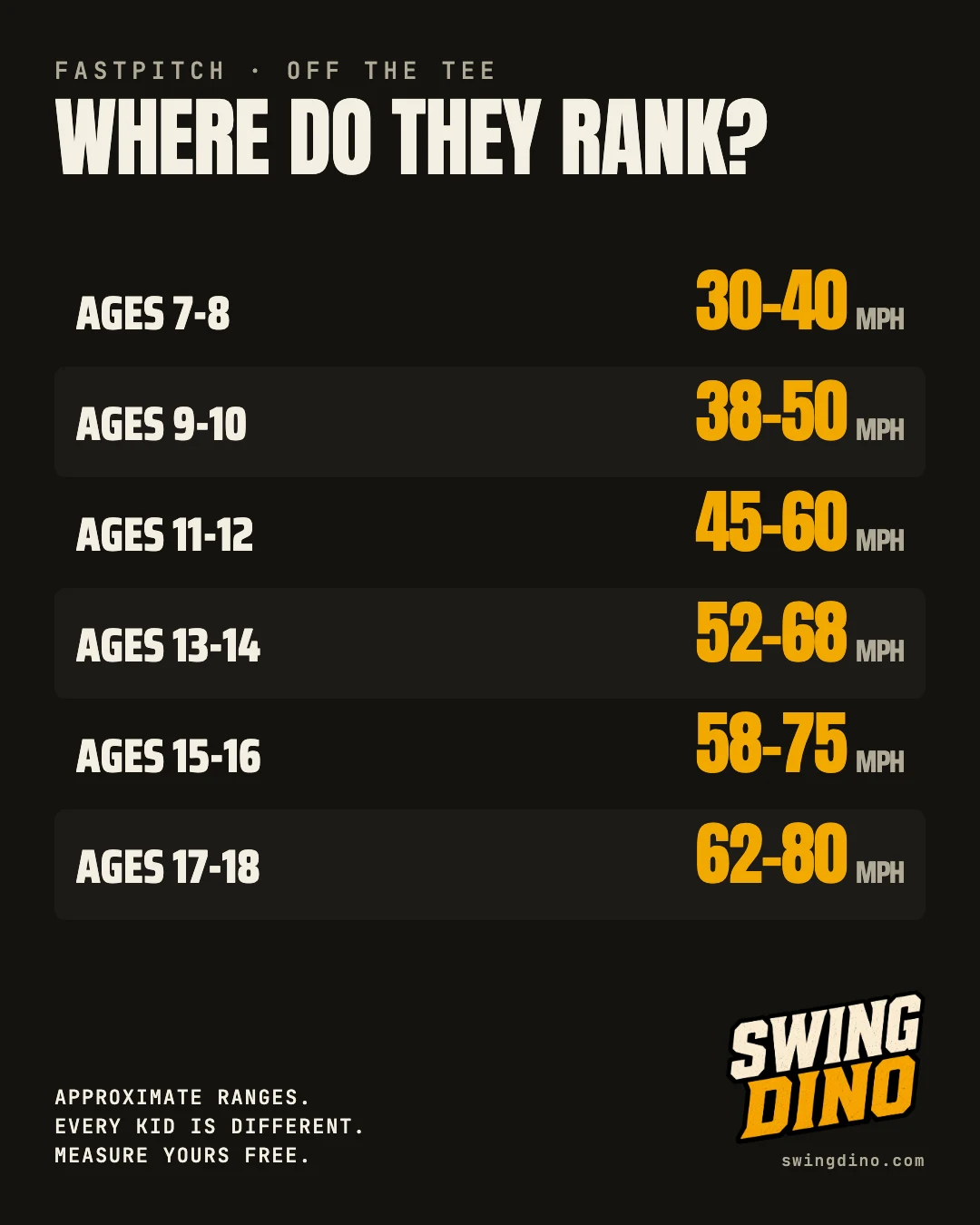
Softball is not small baseball
One thing before the drills. Fastpitch is its own sport, not baseball on a smaller field. A good rise-ball pitcher from 43 feet leaves a hitter roughly a fifth less reaction time than a baseball hitter gets, so fastpitch swings stay compact and timing work matters more, not less, as girls get older. That is why the drills below lean harder on contact spot and timing than the baseball version of this post does. And softball has something baseball does not: the slap game.
How to tell a drill is working
Take a baseline before you change anything: ten swings off a tee, same tee height, same ball, same spot. Write down every reading (or measure with your phone), mis-hits included. Then watch two numbers over the following weeks: the average, and the spread between her best swing and her typical swing. A drill that works moves the average and tightens the spread. A drill that produces one loud outlier and a wider spread is teaching her to sell out, and that shows up later as swings and misses on good pitching.
Ages 6-8: tee games, not mechanics
At this age softball and baseball are effectively the same sport, and the official curricula treat them that way. Little League's tee ball program, a free 10-week plan with practice plans and Positive Coaching Alliance tips baked in, runs hitting as stations: small groups behind a tee, taking turns, lots of swings. That structure is the drill.
Drill 1: Smash Count
Setup: tee at mid-thigh, ball over the middle, hitting into a net or open grass. Reps: 10 swings; she counts her own smoked ones, hard line drives only. Dribblers and pop-ups do not count. What improvement looks like: the smash count climbs from 3 in 10 toward 6 or 7, and if you measure, the low readings disappear first.
Drill 2: Knock the Target Down
Setup:a cone, a bucket, or a glove out in the field. The only instruction is the target: "knock it down." Why coaches run it this way: the game goal does the coaching. Kids this age learn from outcomes and demonstrations, not from body-part lectures, which is exactly how the official youth curricula are written.
Ages 9-12: contact spot and the front-toss ladder
This is where a real baseline is worth keeping and where the softball-specific work begins.
Drill 1: The Road Map (Tony Baldwin, Georgia head coach)
Georgia's Tony Baldwin, with Danielle Gibson, teaches this through the NFCA: put a marker on the ground at the hitter's ideal contact spot, then take front-toss reps trying to feel contact happen right there, every time. His line for why: "If you don't know where you're going, any road will get you there." A repeatable contact spot is the foundation the rest of the swing gets built on.
Drill 2: The Tee-to-Front-Toss Ladder
The progression Little League University teaches (their softball drill library includes college coach Lisa Dodd's long tee work): earn the tee first, because it removes speed and movement and lets the hitter just learn contact, then move to soft toss for contact points by pitch location, then underhand front toss from behind a screen for timing. Professional hitters never graduate from this ladder; they run it daily.
Ages 12-16: timing, and the slap game
Drill 1: Two Plates (Fran Strub, Boise State)
The fastpitch reaction-window drill. Boise State's Fran Strub sets up two home plates, one behind the other: the back plate simulates a slower pitch, the front plate a faster one, and the hitter moves between them during front toss. Her reasoning, via the NFCA: "Sometimes hitters can have a great swing, but bad timing. With this drill we're looking for hitters to understand how to make quick adjustments." Fix lateness with timing work like this, not by shortening a good swing.
Drill 2: Three-Target Slap Work (Karen Weekly, Tennessee head coach)
For the short-game players. Tennessee's Karen Weekly, with Aubrey Leach, teaches the soft slap as bringing the knob inside the ball and rolling through the top of it for topspin and a couple of hard bounces through the infield. For the hard slap, she sets three stationary targets: a one-hop rocket at an infielder, a line drive, and a backspin fly ball, so the slapper learns to pick her result on purpose.
Drill 3: Slap Footwork (Caitlin Lowe, and Natasha Watley)
Lefties only, and footwork first. Caitlin Lowe teaches the slap as three pieces: the drag step, the crossover step, and driving out of the box, with everything else stemming from the feet. Her drag-step rule: split your body in half, and the front foot never crosses the halfway point. Her aim rule: angle that first step, and the crossover after it, toward the shortstop, so feet, hips, and shoulders all point where the ball should go. And her warning about the classic young-slapper fault, racing toward first base too early: it makes it "really hard to stay on anything on the outside half of the plate." Two-time Olympian Natasha Watley teaches slapping publicly as well, including a free MLB Play Ball demo, and her material is worth every lefty's time. Drill all of this dry, no ball, before adding front toss.
What good coaches say NOT to do
- "Squish the bug."Spinning the back foot in place traps weight on the back side. Matt Antonelli, a former MLB first-round pick whose free channel covers baseball and softball hitting, published a whole video on how to stop doing it, and Driveline's hitting staff dismiss it in one line alongside chopping down.
- "Swing down at the rise ball." Almost every pitch a young hitter sees is falling as it crosses the plate. The answer to a true rise ball out of the zone is to not swing at it, which is a recognition skill, not a swing change.
- Coaching a 9-year-old like a college hitter. The official youth curricula and the modern player-development shops agree from opposite directions: young hitters need games, targets, and lots of swings while they build their engine, not a checklist of joint angles.
Track it honestly, or you're guessing
Every coach above runs drills against feedback: targets, contact spots, results the hitter can see. The number version of that is a weekly Ten-Swing Test, same tee, same ball, same setup, and watching the average and the spread move over a drill block. That is what SwingDino's free tier does with the phone you already own, and it benchmarks softball against softball, never against baseball numbers. We are honest about how we measure and where the limits are. Got a radar in the equipment bag? Run ten swings with the phone right next to it and compare.
Pick one drill from her age band, take a baseline this week, and let a month of trend data tell you the truth. Join the free beta and get an instant TestFlight invite.
Coach credits and sources: Tony Baldwin and Danielle Gibson, Fran Strub, and Karen Weekly and Aubrey Leach via the NFCA's public drills article; Little League University's softball drill library and tee ball program; Caitlin Lowe's public slap footwork video; Natasha Watley; Antonelli Baseball. The drills are general coaching knowledge; the craft of teaching them belongs to these coaches.
Frequently asked questions
What are the best softball hitting drills?
The staples college coaches teach publicly: tee work and front toss for contact, a contact-spot drill like Georgia coach Tony Baldwin's Road Map, and a timing drill like Boise State coach Fran Strub's two-plate setup, because fastpitch gives hitters less reaction time than baseball. For lefties, slap footwork drills from coaches like Caitlin Lowe and Natasha Watley.
Are softball hitting drills different from baseball drills?
At ages 6-8, no, the games are effectively identical and the drills are too. Divergence starts around 9-10: fastpitch hitters face a shorter reaction window from 43 feet, so timing drills matter more, the load stays compact, and softball adds slap hitting, which baseball does not have.
What softball hitting drills work for beginners?
Tee games that reward hard line drives, with one simple outside cue like a target to knock down. No mechanics lectures. Little League's official tee ball curriculum is built exactly this way: stations, turns, and lots of swings.
What is slap hitting in softball?
A left-handed technique where the hitter starts moving toward first base before contact, using a drag step and crossover, and puts the ball on the ground or on a line to beat the throw. It is fastpitch-only and has its own footwork rules, taught publicly by coaches like Caitlin Lowe.
Run a drill. Watch the number move.
SwingDino reads the exit velo off the tee and charts the trend, free on iPhone during the beta.
Sign up for the beta